
The best time to visit Mount Cook
Summer brings long days and open tracks, winter brings snow on the peaks and quiet car parks. Rain falls all year in the village, so a spare day matters more than the month you pick.

Short helicopter flight with alpine landing
Helicopter, alpine landing · 25 minutes
✓ Free cancellation
from NZ$ 349
Book on GetYourGuide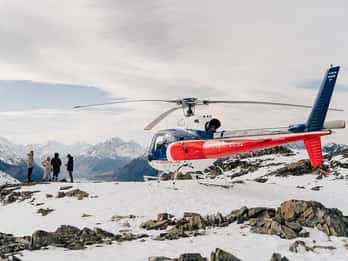
Ben Ohau Range with a mountaintop landing
Helicopter, alpine landing · 35 minutes
✓ Free cancellation
from NZ$ 595
Book on GetYourGuide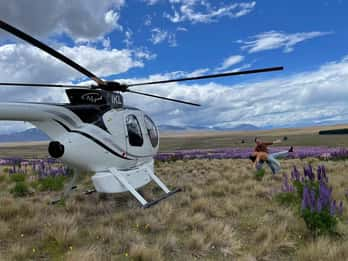
Lupin season flight with a field landing
Helicopter, field landing
✓ Free cancellation
from NZ$ 380
Book on GetYourGuide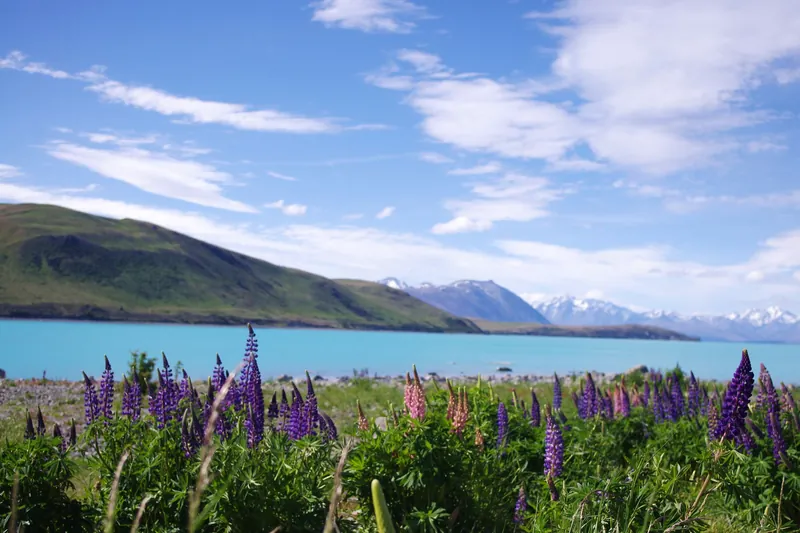
The DOC visitor centre in Mount Cook Village opens every day, and the main helicopter and ski plane flights from Mount Cook Airport are offered all year. What changes with the season is the length of the day, the snow line, the ice on the tracks and the number of people at the start of the Hooker Valley Track. The visitor centre works with two seasons: a summer peak from October to April and a quieter winter from May to September.
Summer, December to February
Around the solstice the sun rises over the village at 05:54 and sets at 21:21, which gives about fifteen and a half hours of daylight. The mountains block the low sun in the Hooker and Tasman valleys for longer than these times suggest, but there is still enough light for a long walk in the morning and another in the evening. January and February bring average highs of about 20 °C in the village and around 22 °C at Lake Tekapo.
This is also the crowded part of the year. Tourism New Zealand notes that the White Horse Hill car park, where the Hooker Valley Track begins, has limited space from November to March, and that the track itself is often full from December to February. An early or late start is the usual way around it. Alpine flowers, among them the Mount Cook lily, are out from December to March.
Rain does not take a summer break. December is the wettest month in the village records, with close to 500 mm on average, and an extreme storm in December 1995 dropped 515 mm in three days. February is noticeably drier at around 260 mm, the lowest monthly figure of the year, with July at 265 mm.
Autumn, March to May
March keeps much of the summer warmth, with average highs around 18 °C in the village, and the days are still long. Daylight saving ends on the first Sunday in April, and from then on the evenings shorten quickly: on 1 May the sun sets at 17:42. Average lows fall to about 4 °C in April and 1 °C in May.
For the Mueller Hut, autumn is the end of the easy season. DOC warns of considerable avalanche danger on the route from April to mid-November, and in winter conditions the climb needs ice axe and crampons and the experience to use them. DOC notes that winter conditions can be present in spring and autumn. Bookings are required for stays from 2 November 2026 to 2 May 2027 and are made on DOC’s Mueller Hut page. Outside those dates the bunks go first come, first served, with tickets from the visitor centre.
Winter, June to August
Winter is short on light. On 21 June the sun rises at 08:14 and sets at 17:09, under nine hours above a flat horizon and less in the valleys. July is the coldest month, with an average high of 7.2 °C and an average low of −2.2 °C in the village, and the NIWA records count close to 100 frost days a year there. On 6 August 2026 Mount Cook Airport was the coldest place in New Zealand at −10 °C.
The trade-off is snow down to the valley floor and far fewer people. The Hooker Valley Track can still be walked, but DOC says shaded sections can become very icy and extremely slippery and recommends microspikes and walking poles. The Sealy Tarns steps can require ice axe and crampons. Snow can also close State Highway 80, the road into the village, so check the road conditions before you drive in.
Tasman Lake freezes over in winter, and the boat trips among its icebergs stop for July and August. Glacier Explorers, run by the Hermitage and booked directly with the hotel, operates from September to June according to the Mackenzie Region tourism office, and the first trips of spring wait until the lake ice has broken up. In summer the trip is busy enough that the Hermitage recommends booking ahead.
The long nights help one activity in particular. In June it is dark soon after 17:45, so stargazing tours around Lake Tekapo and Twizel start early in the evening instead of close to midnight. Read more on the stargazing page.
Spring, September to November
Spring is the wettest stretch in terms of rain days, with 15 to 16 a month in the village. Daylight saving starts on the last Sunday in September, which moves sunset past 19:45 by early October. By 1 November the sun is up for about fourteen hours.
On the farms around Tekapo and Twizel, spring means lambs. The petting zoo in Twizel offers bottle-feeding from November to February, and the one in Tekapo township when lambs are available. One helicopter operator south of Lake Tekapo runs a flight over the lupin fields only from November to January.
Snow on the landing site
Snow landings are the main reason many people book a flight, and the season matters more here than for any walk. The operator of the 25-minute helicopter flight from Mount Cook Airport says its landing site has snow most of the year, but reviews from February mention landings on bare rock. The Ben Ohau Range flight from Glentanner describes snow-covered tops from May to September. For the ski plane and helicopter combination, which lands on the upper Tasman Glacier, the operator states that these mountains carry snow and ice all year round. All flights depend on the weather on the day, so plan a flight early in your stay to leave room for a second attempt. Details are on the scenic flights page.
Two climates an hour apart
The village and Lake Tekapo are only about 100 km apart, yet their weather differs sharply. Mount Cook Village receives more than 4,000 mm of rain a year, spread over around 14 rain days a month. Lake Tekapo gets roughly 500 to 600 mm, depending on the period measured, and NIWA ranks it among the five sunniest places in New Zealand in many years. A base in Tekapo or Twizel therefore puts you in the drier part of the region, about an hour or more from the village by car. The weather and clothing page has the monthly figures, and the itineraries show how to arrange a stay around them.
UV levels are high from September to April, and in the mountains and around snow and ice SunSmart rates them as damaging all year round.
All tours side by side
Tours whose experience depends on the season: helicopter landings that may or may not be on snow, a flight offered only while the lupins flower, and farm visits with lambs in spring and summer.
| Tour | Format | Duration | Age | Rating | From |
|---|---|---|---|---|---|
| Short helicopter flight with alpine landingMount Cook Ski Planes and HelicoptersA flight up the Tasman Valley and over a glacier lake to a mountain landing facing Aoraki, with snow on the landing site most of the year but not in every summer month. | Helicopter, alpine landingFlight, landing, pilot commentary | 25 minutesMount Cook Airport | – | 4.8 (524 reviews) | From NZ$ 349Free cancellationBook on GetYourGuide |
| Feeding farm animals in Tekapo townshipGo TekapoAt the petting zoo in the centre of Lake Tekapo you hand-feed Merino sheep, alpacas, pigs and cattle, and bottle-feed lambs when available. | Petting zooEntry, one bag of feed | 30 minutesFarm & Gift Shop, Lake Tekapo | – | 4.9 (145 reviews) | From NZ$ 20Free cancellationBook on GetYourGuide |
| Ben Ohau Range with a mountaintop landingThe Helicopter LineYou fly over the Ben Ohau Range and land on a high vantage point, with snow on the peaks from May to September. | Helicopter, alpine landingFlight, landing, transport from the village on request | 35 minutesGlentanner Park | Children with a paying adult | 4.9 (8 reviews) | From NZ$ 595Free cancellationBook on GetYourGuide |
| Twizel petting zoo with alpacas and tahrGo TekapoYou hand-feed alpacas, sheep, tahr and horses in an enclosed area, with lambs to bottle-feed from November to February. | Petting zooSession with the animals, feed | 45 minutesTwizel Petting Zoo | – | 5.0 (3 reviews) | From NZ$ 30Free cancellationBook on GetYourGuide |
| Lupin season flight with a field landingMackenzie HelicoptersOffered only from November to January, this flight crosses the lupin fields near Lake Tekapo and lands in a private field for photos. | Helicopter, field landingFlight, private landing, pilot | Helicopter base south of Lake Tekapo | – | – | From NZ$ 380Free cancellationBook on GetYourGuide |
Prices and ratings come from the booking platform and are shown in New Zealand dollars per person. If you book through these links we earn a commission. Your price stays the same. Sorted by number of reviews.
Questions travellers ask
What is the best month to visit Mount Cook?
For walking, October to April is the main season, and February is the driest month in the village, at about 260 mm, with July close behind at 265 mm. For quiet roads and snow on the peaks, June to August suit better, as long as you can handle ice on the tracks and short days.
Is Mount Cook worth visiting in winter?
Yes, if you plan for it. The Hooker Valley Track can still be walked, but it gets very icy in shaded parts, so DOC recommends microspikes and poles, and snow can close State Highway 80. In return the lakes freeze and the car parks are far less crowded.
When are the icebergs on Hooker Lake and Tasman Lake?
DOC describes icebergs in summer and lake ice in winter. Tourism New Zealand adds that the Tasman Lake usually freezes over in winter.
Will a helicopter flight land on snow in summer?
Not always. The operator of the 25-minute flight from Mount Cook Airport says the landing site has snow most of the year but not in every summer month, and the Ben Ohau flight from Glentanner promises snow-covered tops only from May to September.
When is the best time for stargazing?
From April to August the nights are long, and in June it is dark soon after 17:45. Around midsummer the evening twilight lasts until about 22:00, so tours start late and some run past midnight.
Where these facts come from
Dates, opening hours and rules change. We checked these pages in October 2026; the official source has the final word.
- DOC: Aoraki/Mount Cook National Park Visitor Centre
- DOC: Hooker Valley Track
- The Hermitage: Glacier Explorers
- Mackenzie Region: Glacier Explorers (season)
- DOC: Tasman Glacier View Track
- DOC: Mueller Hut
- DOC: Mueller Hut Route
- Tourism New Zealand: Aoraki / Mount Cook
- NIWA: The climate and weather of Canterbury, 2nd edition (PDF)
- Figure.NZ (NIWA data): Mean minimum and maximum temperatures in Mt Cook
- Figure.NZ (NIWA data): Annual rainfall across selected New Zealand locations
- US Naval Observatory: Sun and twilight data for Mount Cook Village
- New Zealand Government: Daylight saving
- SunSmart: UV radiation
- Tour pages on GetYourGuide, checked 19 October 2026

